A global pledge to protect drinking water from lead
Our goal is to work collectively towards preventing lead-leaching from new drinking water systems by 2030 and to make all drinking water lead free by 2040.
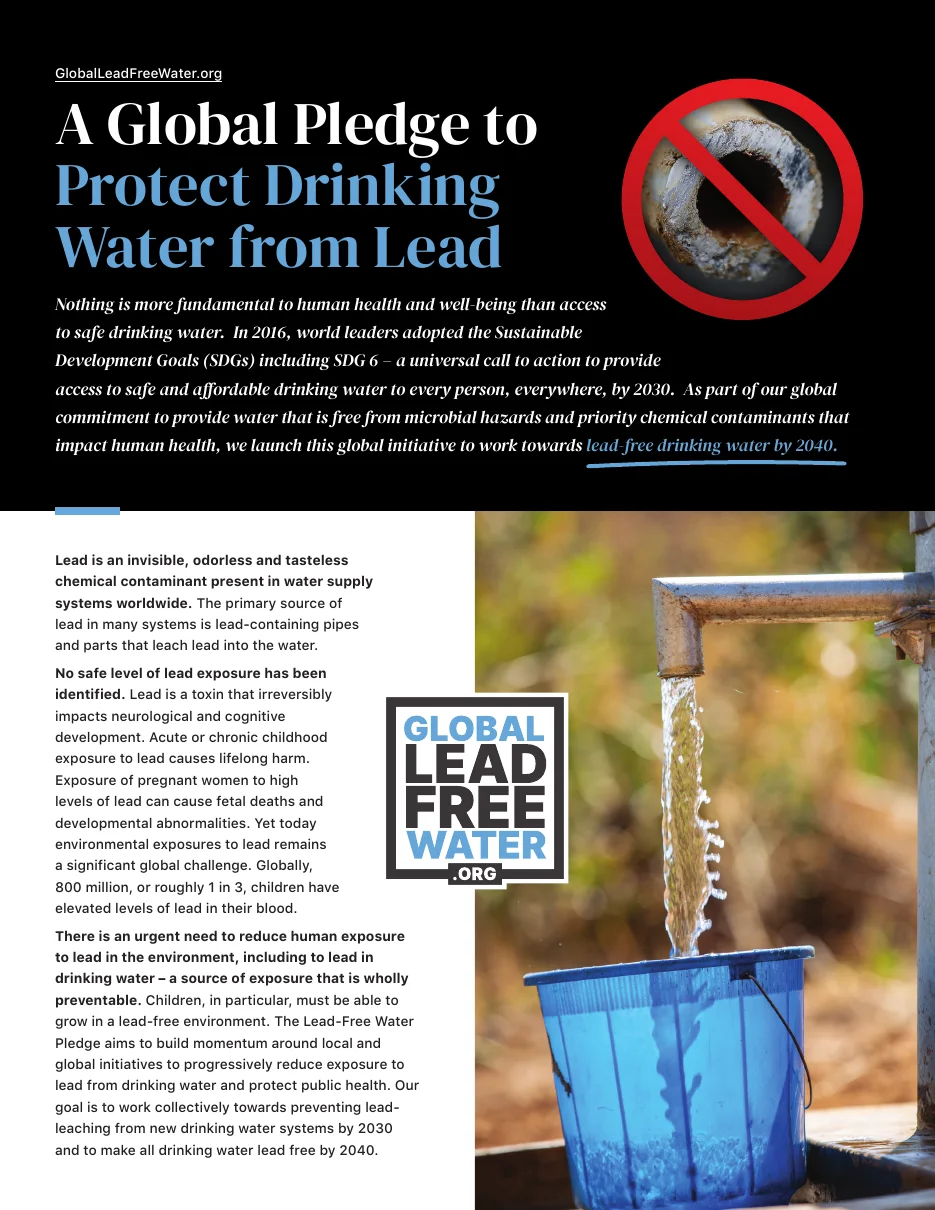
Nothing is more fundamental to human health and well-being than access to safe drinking water. In 2016, world leaders adopted the Sustainable Development Goals (SDGs) including SDG 6 – a universal call to action to provide access to safe and affordable drinking water to every person, everywhere, by 2030. As part of our global commitment to provide water that is free from microbial hazards and priority chemical contaminants that impact human health, we launch this global initiative to work towards lead-free drinking water by 2040.
Two goals, two deadlines
What lead is
Lead is an invisible, odorless and tasteless chemical contaminant present in water supply systems worldwide. The primary source of lead in many systems is lead-containing pipes and parts that leach lead into the water.
Why it matters
800 million
No safe level of lead exposure has been identified. Lead is a toxin that irreversibly impacts neurological and cognitive development. Acute or chronic childhood exposure to lead causes lifelong harm. Exposure of pregnant women to high levels of lead can cause fetal deaths and developmental abnormalities. Yet today environmental exposures to lead remains a significant global challenge. Globally, 800 million, or roughly 1 in 3, children have elevated levels of lead in their blood.
What this pledge does
There is an urgent need to reduce human exposure to lead in the environment, including to lead in drinking water – a source of exposure that is wholly preventable. Children, in particular, must be able to grow in a lead-free environment. The Lead-Free Water Pledge aims to build momentum around local and global initiatives to progressively reduce exposure to lead from drinking water and protect public health. Our goal is to work collectively towards preventing lead-leaching from new drinking water systems by 2030 and to make all drinking water lead free by 2040.
The Lead Pledge
We, the Participants in the Global Pledge to Protect Drinking Water from Lead:
- Remain committed to achieving SDG 6 and providing safely managed drinking water services to everyone, everywhere.
- Recognize that environmental exposures to lead threaten the healthy development of children worldwide, and that controlling these exposures is essential to achieving safely managed water services.
- Acknowledge that all unsafe lead-leaching materials in water supply systems are a major factor in childhood exposures to lead through drinking water.
- Further recognize that while additional work can enhance our understanding of the sources and health impacts of lead in water, the evidence around lead exposure from lead-leaching materials in water systems is clear and that these risks can be wholly prevented through dedicated action.
Agree to work collectively to protect drinking water from lead through the following actions:
- 01
We will ensure that all new water systems are constructed with products and materials that meet international standards for lead-leaching, material safety, and performance.1
- 02
For existing water systems that may contain lead-leaching materials, we will develop and implement plans for periodic water lead monitoring and data sharing, including the communication of monitoring results.
- 03
We will investigate water systems reporting lead levels at 10 ppb (the WHO guideline value) or above to identify contamination sources and implement necessary interim or long-term remedial measures to reduce human exposure.
- 04
Support communities to reduce or eliminate exposure to lead through education and action such as designating safe taps for drinking and cooking.
To implement these commitments, we will:
- Support the adoption of national policies and regulations based on international standards and testing/certification requirements for products and materials used in drinking water systems that address lead-leaching, material safety, and performance.
- Support manufacturing of products and materials used in drinking water systems that meet international standards for lead-leaching, material safety, and performance.
- Support affordable access to fittings, fixtures and filters that meet international standards for lead in drinking water.
- Support the development of low-cost technologies to enable widespread testing for lead in drinking water and materials to better understand the sources, impacts, and mitigation/remediation of lead contamination in drinking water.
- Support the training and certification of professionals to oversee the design and construction of safe drinking water systems.
- Support and develop national and local laboratory and monitoring capacity to assess and monitor lead in drinking water and materials to support implementation of these commitments.
- Support high-quality research to better understand and identify sources, impacts, and effective prevention and remediation methods and approaches to minimize harm from lead in drinking water.
We welcome and encourage the announcement of parallel actions taken by the private sector, manufacturers, suppliers, development banks, financial institutions and philanthropy to support global efforts to provide drinking water that is lead-free.
We resolve to review progress towards our goals to prevent lead exposure from new drinking water systems by 2030 and to make all drinking water lead free by 2040 through national reporting processes and Voluntary National Reviews at the United Nations High-Level Political Forum.
Founding partners
Government and Intergovernmental Organizations2
 Ghana
Ghana South Africa
 Uganda
 UNICEF
 World Health Organization
Non-Governmental Organizations
 Int’l Assoc. of Plumbing & Mechanical Officials
 Rural Water Supply Network
 UNC Water Institute
 University of Leeds
 WaterAid
 World Vision
47 partners have joined
see all partners









We call on states and organizations to join the Global Pledge to Protect Drinking Water from Lead.
How to join
- 1
Read the pledge
The goals and every commitment are set out above, and the document itself is one click away. Download the pledge (PDF)
- 2
Choose your commitments
The partner form lists each commitment, so your country or organization can select the ones it is taking on.
- 3
Our team follows up
After you submit the form, our team will follow up with you about becoming a Partner on the Pledge.
- Relevant international standards and guidelines can be found at: “Lead in drinking-water: Health risks, monitoring and corrective action” (WHO) and NSF/ANSI (e.g., NSF ANSI 372 (Lead Content), NSF/ANSI 61 (Lead Leaching Performance)). More resources are available at globalleadfreewater.org.
- Within the context of the World Health Organization’s work on water quality and safety, the WHO is committed to supporting Member States in achieving the commitments in this pledge.